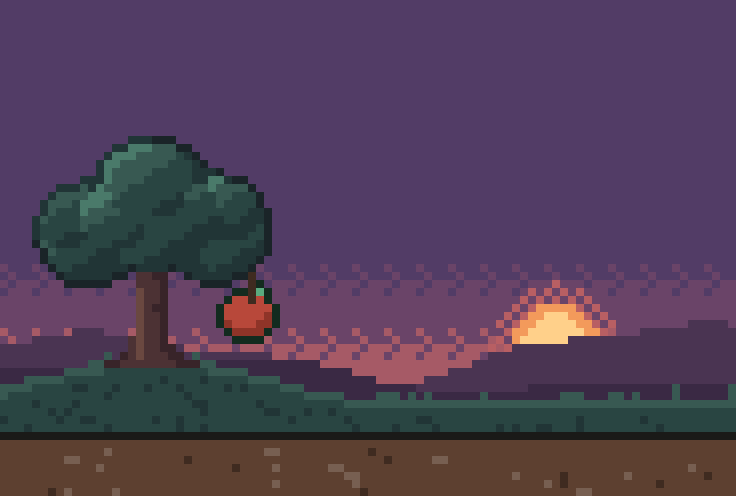
The home page opens on a pixel diorama, a tree on an empty field with one apple you can pick, under a sky in five bands that follows the visitor's own clock. Scrolling pushes that clock forward to the next sky while the scene holds still, so a visit that lands on a sunset ends under the night sky.
How it's drawn
Every pixel stays square. The scene is drawn at its own small size and scaled up by a whole number. The parts that never move are drawn once per sky, the rest redraws only while the scene is on screen, and nothing moves under reduced motion.
There's no flash of the wrong sky on load. Each sky's band and headline colors live in CSS, and the page reads the visitor's clock before anything paints.
The headline needs clear sky behind it. The bands meet in short checkered seams, and a seam behind a line of text reads like a zipper, so the seams sit above and below the text box. Stars stay out of the box, clouds stay above it where there's room, and the body text holds 4.5:1 against every band and cloud that can sit behind it.
Hold, then let go
Scroll, and the scene pins under the nav while the card for my game rises over it. Once the card is in place, the two scroll away together, the card just above the grass.
The hours up to the next sky fit the hold exactly, so every scroll lands on that sky's resting picture as the scene lets go. The headline fades first, before the sky starts to turn.
The clock
Four skies, resting at 8:00, 12:00, 18:00, and 22:00. I set those hours so the changes come during waking hours, which makes dawn and dusk four hours long, day six, and night ten. A sky is fully in at its resting hour and blends in over the two hours before, so a scroll is the same sky with the sun or moon on the move, then the blend at the end. Scroll back up and it rewinds.
As the sky darkens, the stars come out, high ones first, then the fireflies, and the hearth on the game card glows brighter. The sun is up from 7:00 to 18:00 and the moon from 19:00 to 6:00. Both cross the sky in the same column, which is why one is always down before the other rises. The hills are drawn in front, so a setting disc sinks behind them.
The dither
Every pixel stays in one sky's palette, so the skies don't fade. A pixel is dusk's purple or night's navy, and halfway to night means half the pixels are night, a checkerboard at the scene's pixel size. A 4×4 Bayer matrix decides which pixels flip first, so every step reads as an even texture, with no stripes. The band seams use the same pattern, and the clouds thin or gather pixel by pixel.
Golden hour
In light mode, day into dusk and night into dawn would be loud, their bands far apart in lightness. A fifth sky, golden hour, bridges them. Nothing rests on it. On the way into dusk or dawn, the old sky turns golden over the first hour and golden turns into the new sky over the second. That takes about 40 percent off the lightness gap in each blend's worst checker.
It runs violet overhead, through coral, to gold at the hills. I tried three golden palettes, and this is the only one that still reads golden under a deuteranomaly simulation. The other two went gray-lavender and taupe.
Sunrise is 7:00, the peak of dawn's golden hour, and sunset lands as dusk's resting picture arrives, so the light matches the sky. For the middle hour of each golden blend the sun wears golden's colors, a warm disc on the coral sky.
Where a visit starts
A visit never opens on a blend. Body text on a checker is hard to read (below), so the dither only ever shows while you scroll.
A visit starts at the visitor's own time, held to the first hour or two of their sky. If every visit opened on the resting picture, a 19:14 visitor would get 18:00's sunset. A visit always starts at least three hours before the next sky's rest, or the next blend would arrive under the headline before it fades.
What's next
Parallax, if the scene feels flat once it's live. While the scene is pinned, the sky would drift down a few rows and the hills half as far, with the ground and the tree staying put under the card and the apple.